Results of the Participatory Survey “What are the Dangers that Threaten Your Safety in Geneva?”
Laura García VargasIn partnership with OPPi, from June 22 to November 15 of 2022, we invited the residents of Geneva to participate in the online participatory survey “What Are the Dangers That Threaten Your Safety in Geneva?”.

J.B.R.
Edgelands is a pop-up institute that creates spaces to explore how the digitalization of urban security is changing the urban social contract. These are spaces for broader discussions about the benefits and challenges in the way that digital tools are being used by city governments and private actors.
To begin our work in Geneva, between February and April 2022, the Edgelands Geneva Team conducted over 40 interviews, and hosted 3 round tables, where we asked different people in Geneva—from members of government, academia, civil society, and regular citizens—How is the digitization of security transforming the social contract of the city?
As a result of those interview and round tables, we wrote the Diagnostic Report GENEVA: A CITY OF PARADOXES AND DUALITIES. The three main findings of this report were i) the issue of security and safety is reserved to exclusive expert circles; ii) the digitalization of society is happening rapidly and the public discussion about it is lacking; and iii) private companies play a prominent role in the digitalization of urban life.
Based on this Diagnostic Report, since June 2022 we have been hosting various spaces where resident of Geneva can explore, think, and discuss about the benefits and risks of the use of digital technologies to provide public security in Geneva and on the going digitalization of our daily lives.
One of these spaces was the online participatory survey, “What Are the Dangers That Threaten Your Safety in Geneva?” In partnership with OPPi, from June 22 to November 15 of 2022, we invited the residents of Geneva to answer some questions, and to leave their comments and opinions. We got 414 respondents, and 114 comments.
The Aim of the Survey
En una época en la que la mayor parte de nuestras vidas está mediada por una tecnología digital, las conversaciones en torno a la seguridad y la inseguridad y las diferentes compensaciones que los individuos están dispuestos a hacer son complejas. Implican a múltiples partes interesadas, intereses, y suelen enmarcarse en términos complejos que requieren un alto grado de conocimientos técnicos.
Así pues, esta encuesta participativa debe considerarse el primer paso de una conversación más larga. Su objetivo era proporcionar una plataforma para el diálogo y la conversación generativos a gran escala, una "varilla" rápida pero potente, en la que examináramos (y descubriéramos) la compleja cuestión de la seguridad y las tecnologías digitales en Ginebra desde distintos ángulos y perspectivas. Si utilizamos la analogía médica, una "varilla" es como el estetoscopio o el médico que luego informa de la elección entre una resonancia magnética, una tomografía computarizada, una radiografía o una ecografía para la siguiente fase de análisis.
Se pidió a los participantes que respondieran a dos tipos de preguntas: afirmaciones de hecho y preguntas de opción múltiple. Las primeras eran declaraciones de opinión sobre distintos temas relacionados con la seguridad en Ginebra, en las que se pedía a la gente que eligiera entre tres opciones: de acuerdo, en desacuerdo o indeciso. Con ellas queríamos medir los sentimientos de la gente sobre estas afirmaciones. Las preguntas de opción múltiple pedían a los participantes que eligieran entre opciones predefinidas sobre datos demográficos (como edad, sexo y ocupación), y sobre sus percepciones acerca de la responsabilidad de su seguridad digital, los datos que se recogen y los actores de confianza. Estas preguntas nos ayudaron a comprender el perfil demográfico de nuestros encuestados, así como a "trocear" los resultados de las declaraciones de semillas en función de cualquiera de estas variables.
Tras responder a todas las preguntas, se mostró a los participantes un resumen en tiempo real de los resultados de toda la encuesta, el grupo de opinión en el que se encuadran y los demás grupos de opinión y la afirmación en la que comparten la misma opinión y en la que difieren. Como parte de la metodología desarrollada por OPPi, mostrar los resultados y los grupos de opinión al final tiene 3 beneficios. En primer lugar, ayuda a los individuos de la sociedad a cultivar la autoconciencia y la conciencia colectiva. En segundo lugar, traslada la propiedad o la carga del problema de los organizadores a la comunidad (es decir, los líderes y los encuestados de la comunidad). En tercer lugar, los participantes empiezan a aportar comentarios y declaraciones más significativos para construir un terreno común con sus iguales.
A continuación encontrará el Resumen Ejecutivo del informe "Citizen Science for Tri-Sector Response: Participatory Citizen Sentiment Crowdsourcing Study in Geneva", donde explicamos con más detalle la metodología de la encuesta y compartimos sus resultados.
Resumen ejecutivo
¿Cómo entendemos la percepción de la seguridad de los residentes en Ginebra? El Instituto Edgelands trató de responder a esta pregunta en su segundo emplazamiento emergente en Ginebra. En el espíritu de la investigación participativa basada en la comunidad (CBPR), el equipo llevó a cabo una serie de entrevistas, grupos de discusión y debates con académicos, estudiantes, socios de los medios de comunicación, expertos en investigación y ciudadanos durante aproximadamente 1 mes para destilar 15 afirmaciones iniciales y 7 preguntas de opción múltiple (MCQ) para una encuesta participativa y emergente que se lanzó el 20 de junio de 2022. Tras revisar el conjunto inicial de resultados de 182 participantes, el equipo de investigación habilitó 2 enunciados iniciales adicionales y 1 MCQ adicional el 18 de julio de 2022. La conversación finalizó el 15 de noviembre de 2022 con 414 encuestados.
El estudio reveló 3 grupos diferentes de opiniones o tribus. El Grupo A (22% de los 414 encuestados) se sentía seguro y protegido en comparación con la mayoría de los encuestados del Grupo B (53% de los encuestados) que se sentían temerosos e inseguros. El Grupo C (22% de los encuestados) se mostraba indeciso o temeroso sobre la seguridad en Ginebra. La encuesta reveló una moderada falta de confianza en las instituciones públicas y una grave desconfianza en las grandes empresas tecnológicas.
To quantify and compare perceptions of fear, we ranked the fears of 7 issues in an ‘Axis of Fear’. It revealed the fear of use of personal data by big tech was the highest; followed by algorithms; then surveillance; digital frauds; improper use of personal data by the government; and lastly the fear of physical security.
We created another ‘Axis of Agreement’ or ‘Axis of Public Approval’ which showed that the trust in the competence of authorities to protect digital life was the lowest; followed by trust in the reliability of and effectiveness of social media and then feelings of security with authorities using more technology to protect citizens. Addiction and attention span contributing to a problem for public health registered the highest agreement; followed by the perception of people in Geneva not reporting digital crimes; the possibility of envisaging a digital service ‘outage’; the feeling of overwhelm from the digitalisation of urban and social life; the difficulty of filling digital government forms; and finally, agreeing that personal data collected by government be stored overseas.
There were 5 issues that were highly divisive which warranted greater public discourse and consensus building in society. They were the following: whether the increased digitalization of urban and social life felt overwhelming; the fear of being a victim of digital frauds; the fear of improper use of personal data by the Geneva government; the fear of use of more technology by the police and government; and finally, the effectiveness of sharing of incidents on social media as compared to reporting to the authorities.
Overall, age and residency status were 2 important identity or demographic markers that accounted for some differences in the way the respondents voted. The qualitative insights from the comments revealed complex layers of nuance and texture that hinted at deeper root causes of issues that needed to be addressed e.g. socio-economic or class divide or a growing digital-literacy divide.
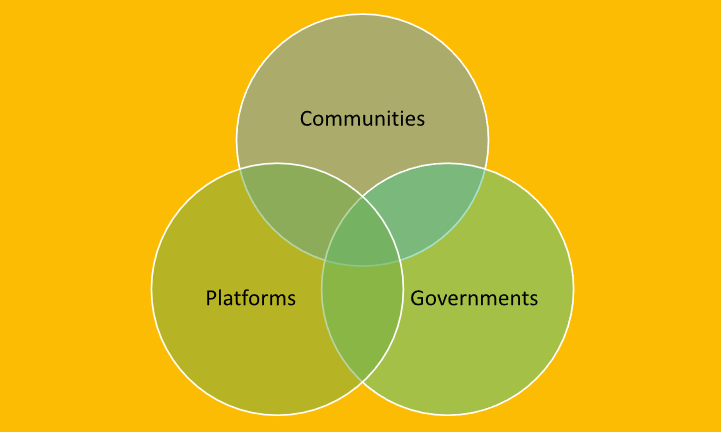
Using the ‘Axis of Fear’, ‘Axis of Agreement’, Decision Matrix and crowdsourced comments as inspiration, we put together a list of 19 detailed recommendations under 9 high-level broad recommendations themes. We visualised these recommendations in a 3X3 matrix which represented 3 different actors in society who could work on several action items along 3 levels of priority. We conclude this Executive Summary with six of the more notable recommendations.
First, there was a sense of resignation or ‘learned helplessness’ that power has tilted too favourably in the hands of big tech companies. Society needs to have a countervailing force to keep big tech interests in check. A trisector “public-people-private” sector partnership of deliberative democracy processes (e.g. vTaiwan) or citizen review committees and citizen panels that explore and sensitise the public to the nuances of the arguments for all stakeholders could help society progress more delicately and artfully towards consensus on such matters. 3rd party audits of the transparency and proper use of personal data by big tech companies would help allay fears by citizens.
Second, more needs to be done by the authorities to earn back the trust of the people. The authorities need to grow and demonstrate their competence to protect the digital lives of citizens. They need to ensure the proper use of personal data of citizens and residents as well as allay fears by citizens on the increased presence of digital surveillance in their daily lives.
Third, downstream justice and law enforcement responses have not developed sufficiently to cope with digital crimes that are evolving at a much faster pace. There is an urgent need for citizens and residents to be educated on their rights to their data and the pathways for recourse when their rights are violated. Better coordination between the police, judiciary and citizens is required to respond quickly to the evolving nature of digital threats.
Fourth, addiction to technologies, the reduction of attention spans, fears of algorithms, and their impact on public health are a ‘ticking time bomb’ ready to implode in the near future if we do not take pre-emptive or proactive steps to addressing the issue. The comments seem to suggest that the problem is out of control and very complex, thus requiring multiple stakeholders to come together to co-operate.
Fifth, society should come together to discuss how the reliability of social media as a source of information and awareness of security threats in Geneva could be improved as well as how it could complement formal reporting channels to the authorities. This is an area of nascent development that requires a more concerted people-public-private sector deliberation that could be stress-tested with a series of scenario-planning exercises.
Sixth, there is a significant proportion of elderly and digitally non-literate minorities in the population that find digital government forms difficult to fill. A policy development framework based on the philosophy of ‘centering the margins’ ought to be adopted to bridge the gap between those with digital literacy and those without digital literacy. One example of this would be having more human assistance for these services and human-centred design digital forms whose UI/UX design are optimised for these minorities.
Here you can read the full report [English Only]
.png)
.jpg)